Wednesday, April 28, 2010

Ode to barley: The grain of good health


Several studies suggest that barley can lower cholesterol levels by 15 per cent in individuals with elevated cholesterol levels. In one study, subjects with hypercholesterolemia were fed barley or oat foods for six weeks. Barley and oat flours were used in equivalent amounts in breakfast cereals, bran muffins, and flat bread recipes. While both barley and oat diets lowered total cholesterol by five per cent, LDL (bad) cholesterol was reduced by 14 per cent in subjects fed barley diet compared to seven per cent in those fed the oat diet.

Barley and oats are a good source of "beta glucan", a water-soluble form of fibre. The viscous fibre seems to retard fat and cholesterol absorption by the intestine. The fibre tends to bind bile salts, thus increasing cholesterol removal from the body. Presence of fat-soluble substances such as tocotrienols (vitamin E) in it appears to suppress cholesterol synthesis by the liver. However, this does not explain barley's efficacy in getting cholesterol levels down. A 100 gm of barley contain about 3 gm of soluble fibre which pales in comparison to oatbran's 7.2 gm. Barley's cholesterol-reducing capacity goes beyond what its soluble fibre content provides. Scientists are trying to figure out what is it about barley that makes it effective.


Another important benefit of barley is its remarkably low glycemic index, which means it releases its carbohydrate much slower than most grains. This property helps increase the satiety value of the meal and offers immense benefits for those with diabetes and obesity.

Barley is a high-fibre, low-fat food that helps to promote satiety. It is also a pre-biotic i.e. it promotes the growth of friendly bacteria. It has been found extremely useful in treating ulcerative colitis, Crohn's disease, constipation and diarrhoea. Barley broth and lemon barley water are also used to treat urinary tract infection.

While several varieties of barley are known, it is mostly used today for preparing malt. Whole barley is available as porridge (cracked) or ground as barley flour. Pearled barley is a refined form which may not be as useful as "whole" for cholesterol reduction. Meanwhile, just add barley to your diet as a flour to make rotis or bread, to porridge, in soup or salad.


Source: Indian Express

Monday, April 26, 2010

Natural Ways to Lighten Your Skin

Natural Ways to Lighten Your Skin

Dark spots, and freckles, and skin-damage - oh my! Looking to lighten your complexion? Every shade of skin is beautiful, but as we grow older our skin tone can change. Freckles may appear, dark spots can arise, and skin may not be as light as it once was. So, if you're still not ready to embrace your dark side, read on for a few natural whitening tips and tricks.

Use Sunblock
One of the easiest ways to stay fair is to use sunblock on a daily basis. Find a moisturizer that includes an SPF of 15 or higher and use it every morning after washing your face. Sunblock not only prevents your skin from getting darker, but also blocks harmful UV rays that can cause cancer and premature aging. Remember your hands when applying sunblock, as they are a prime area for age spots.

Exfoliate
Exfoliating once a week will remove dead skin cells to lighten and brighten your skin. Mix two tablespoons oatmeal and two tablespoons brown sugar with a quarter cup of milk, and stir until a paste forms. Gently scrub your face, rinse, and moisturize.

Make a Mask
A homemade mask is a great way to lighten your skin and a good excuse to kick back on the couch. Try using one once a week. Use one tablespoon of each of the following: sandalwood paste, lemon juice, tomato juice, and cucumber juice. Mix them all together to form a paste. Spread the mixture on your face and wait until it dries. Rinse and moisturize for a natural glow.

Licorice Extract
Licorice extract contains glabridin, a component that acts as a natural skin whitener. Apply a thin layer of the extract morning and evening, after you wash your face and before you moisturize. Licorice extract can be found at any health food store or ordered online. Be sure to store the bottle in a cool, dark place to maintain freshness. 

Note : Test a small amount on the back of your arm before using on your face to be sure you do not have an allergic reaction.  

Remember to love your skin no matter what color it is. It's a part of who you are and that's what makes you beautiful and unique.


Tuesday, April 6, 2010

TIPS FOR REDUCING STRESS - Part 1


1.   Laugh.
When you laugh, you actually cause a pleasurable change in your body’s chemistry that lasts as long as 45 minutes. So take in a comedy at the movies, watch a funny television show, or invite friends over for a game of charades.


2.   Pets.
Physical contact with pets or even just their presence has been proved to be therapeutic for hospital patients. Play with your dog, hold your cat, or sing to your bird: all of these activities can help reduce blood pressure and bring a feeling of calm.


3.   Nature.
The soothing, stress-relieving power of nature has been recognized for centuries. Many hospitals and health centers now make “nature areas” a part of their therapeutic environment. And when properly tailored to the individual’s conditioning and enjoyment, physical exercise can help reduce stress and anxiety. Take a walk outside!


4.   Music.
Music’s calming effect has been proved during dental procedures, during labor, before and after surgery, and in emergency rooms. This effect is probably due to music’s ability to distract and soothe.


To Be Continued....

Monday, April 5, 2010

10 Health Benefits of Water :


Our bodies are made up of mostly water. Just look at the facts: The brain contains 74% water, blood contains 83% water, lean muscle has 75% and bone has 22% water. Experts agree that water is one of the most powerful forms of treatment. So how come most people don't drink enough water? 


1. Water prevents kidney stones. The most common cause of kidney stones is not drinking enough water. Since water dissolves the substances that form stones in the urine, drinking 12 glasses daily helps treat kidney stones. 


2. Water treats urinary tract infection. The more water you drink, the more you will urinate. "Drinking lots of water will help flush out harmful bacteria from your bladder," says Medical City kidney specialist Dr. Roberto Tanchanco. 


3. Water helps patients with diarrhea by preventing dehydration. As a first-aid for diarrhea, you can make your own oral rehydration solution at home. Mix a glass of water with 2 teaspoons sugar and ¼ teaspoon salt, and drink as much as you can tolerate. This is similar to the dextrose solution in the hospital. 


4. Water helps reduce fever. For symptoms of flu, water can help lower your body temperature when you urinate the "heat" out of your body. If you're sick, drink more water for you to recover faster. 


5. Water helps treat cough and colds, sore throat, and respiratory infections. Water helps loosen sticky phlegm. A respected lung specialist told me that some mucolytics out there are just as beneficial as drinking lots of water.


Continued...

Source : By Dr. Willie T. Ong

Tuesday, March 30, 2010

Major Facts For Stress - Part 2

We continue today with the remaining major facts of STRESS.

5. It can be lessened through healthy intimate relationships. Psychiatrists also found out that for the avoidance of excessive stress being married is better than being divorced or single.

6. There are major stressful events connected to it. Studies also showed that the death of a child is the most stressful of any life’s events. Other items include a jail sentence, major financial problems, divorce and the beginning of an extra-marital affair. Some of the environmental factors that may be related to stress are the status of health, the social class, and the size of the household.

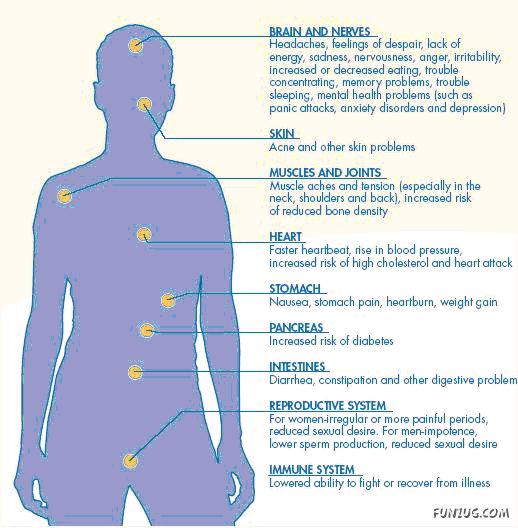
7. There are also some stresses that cannot be controlled. Too much stress can show itself in various emotional, behavioral and physical signs, and the signs of stress differ extremely according to each individual.


Usual Physical, Emotional and Behavioral Signs of Stress :

The physical indications of stress include sleep interruptions, tense muscles, annoyance, gastrointestinal problem, and exhaustion. Its emotional and behavioral indications consist of apprehension, fear, alterations in eating practices, depleted energy, and mood swings. All of the symptoms given cannot tell whether a person has an elevated stress level because these indications may be due to other medical or mental problems.

It is also a fact that persons in stress are most likely to maintain harmful activities like drug and alcohol addiction, excessive cigarette smoking, and poor eating habits. These harmful activities can extremely add to the severity of the indications connected to stress.

Remember that all people may be prone to stress, no matter what age you are in and no matter what status of life you have. The extent may vary also depending on how you take up the challenge that goes with it. If you have a support system with you, it is easy to do away with the situation. But at the worse, it may only lead you to panic attacks.

Concluded.....


Image Credit : Funzug.com
Source : Indian Express

Monday, March 29, 2010

Major Facts For Stress - Part 1

STRESS is already a part of daily living. You may never know it but you are already affected by this issue. You shout at your kids or nag your partner about something. You seem to raise an issue out of a particular event even if it is not true. You also tend to be suspicious at some points. All these are due to stress.

Scientifically, stress is a state of high tension or pressure, resulting from an accident or injury or a psychological reaction of heightened emotional response. Certain occupations are particularly stressful, such as acting, advertising, controlling air traffic, politics, investing and gambling. As an effect of stressful emotions such as panic attacks, fear and anger, the blood pressure rises, the pulse beats faster, breathing is accelerated, digestion stops, and the adrenal glands become overactive.


MAJOR FACTS FOR STRESS:


1. It can be caused by many factors. Fear and anxiety are the greatest causes of psychological stress. In modern times people are constantly beset by the threat of calamities. They fear depression and inflation, unemployment, cancer and heart failure, missiles and bombs and famine. At home they may be confronted with marital incompatibility, quarrels, family illness, or financial troubles.

2. It can also cause something. Many illnesses are caused by mental stress, including ulcers, spastic constipation, diarrhea, high blood pressure and migraine headaches. Sometimes latent mental disorders are precipitated by stressful circumstances, as in the case of manic-depressive psychosis, schizophrenia, hysteria and neurasthenia.

3. It can worsen through time. When a person is subjected to repeated stresses, she is likely to develop what people call nervous breakdown, an unscientific but expressive term. The stress produced by the problems of everyday living has led to the widespread use of tranquilizers, a last resort when there seems to be no escape from a difficult situation.

4. It happens in daily living. Stress exists in almost every human activity and is not the same as nerve tension. Some stress is beneficial since it may stimulate action.
To Be Continued.....


Image Credit : Funzug.com
Source : Indian Express

Friday, March 26, 2010

10 Great Ways to Burn More Fat - Part 2


Yesterday we saw 5 ways to Burn more FAT. Today we take look of the rest 5 ways.

6. Tired at night and just want to sit in front of the TV? Try this technique: take periodic five-minute exercise breaks and perform some muscle stimulating and calorie burning exercise. For example, take five minutes and perform only ab crunches. Then, when its time for another five-minute exercise break, perform modified push-ups for five minutes. Then for a final five-minute break, perform stationary lunges. Try to do as many as possible in five minutes and try to beat your amount of reps during each subsequent break. It wont seem daunting because its only five minutes at a time, split over a 30 or 60 minute timeframe. Instead of rest breaks, you will take exercise breaks.

7. How about performing one exercise movement per day for seven to 10 minutes? For example, Monday: free-standing squats for seven minutes. Tuesday: chair dips for seven minutes. Wednesday: crunches and hip lifts off the floor for seven minutes. Thursday: modified push-up for seven minutes. Friday: stationary lunges for seven minutes. Its quick, simple and teaches consistency.

8. Want things even simpler? Take the longest route every time you have to walk somewhere even if its to a co-workers office.

9. Double-up the stairs. Everytime you take the stairs, simply take a double step walk or every other stair. It will be just like lunges and the Stairmaster combined. Great for the legs and butt.

10. Perform any of the above with your spouse or a friend. You can find someone who is in the same situation. The support will give you more motivation and you just may find that you can create even more workout time for yourself.

---------------------------------------------------------------------------

Disclaimer : The reader of this article should exercise all precautionary measures while following instructions of this article. The responsibility lies with the reader and not with the site or the Writer/Sender.

This EMAIL is provided as general information only, and should not be treated as a substitute for the medical advice of your own doctor.